The Return of Protectionism
For a long time, businesses treated tariffs as an exception to the rules of global trade. Governments might protect a sensitive industry or retaliate against a trading partner, but the assumption was that commerce would eventually return to something resembling normal.
What the Global Tariff Surge Means for Business in the Gulf
A New Kind of Exposure
For businesses in the Gulf, this matters even when the UAE is not the direct target of the policy.
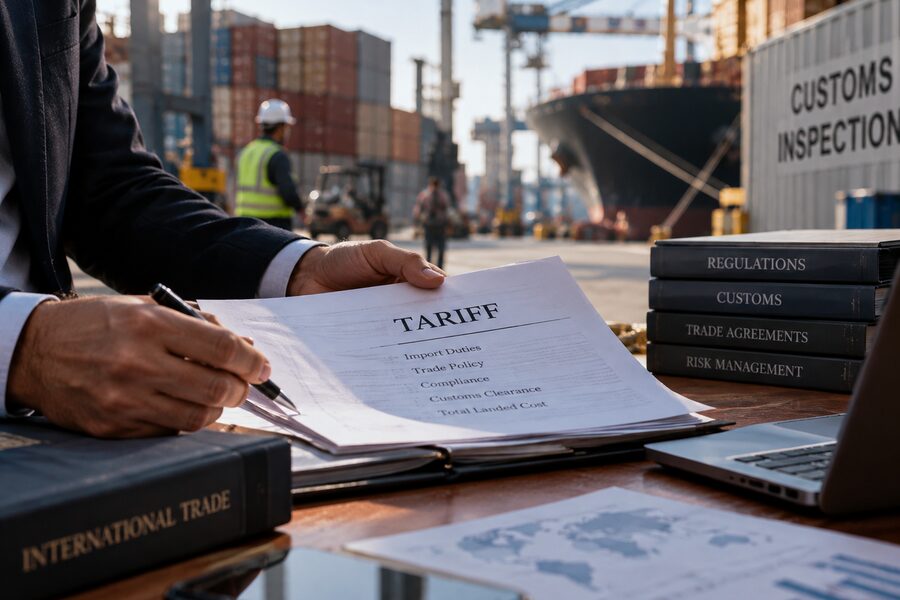
Consider a company in Dubai buying from Asia and selling into Europe or North America. A contract may be commercially sound when it is signed. The commodity price may not move. The supplier may perform exactly as promised. Yet before delivery, a new tariff can change the landed cost of the transaction.
Someone must absorb that difference.
The buyer may demand a discount. The seller may refuse. The importer may surrender part of its margin. Financing assumptions made months earlier may no longer work.
This is the less visible cost of protectionism: policy becomes another variable in price.
2026 Is Different
That assumption — that trade eventually returns to normal — is becoming harder to maintain.
The tariff disputes of 2018 were concentrated largely between major economies. The interventions of 2020 were driven by an emergency. What distinguishes 2026 is something different: trade intervention is becoming broader, more simultaneous and more permanent.
The WTO-IMF Trade Policy Activity Index reached a new high in early 2026. Between January and May, global trade-policy activity was running at nearly twice its 2024 level and around 25 per cent above the 2025 average. Restrictive measures — tariff increases, import bans and quantitative restrictions — have risen particularly sharply, while subsidies have continued to expand.
And this is no longer confined to the largest economies. Intervention has increased across G20 and non-G20 countries alike. It is not simply another trade dispute. It is a change in the economics of doing business.
The Pharmaceutical Precedent
Pharmaceuticals provide a useful example. The United States has introduced a headline tariff of 100 per cent on specified patented pharmaceutical imports, subject to substantial exemptions and preferential arrangements. Implementation is being phased between July and September.
The significance lies less in the product than in the precedent. A tariff of this scale does not merely increase the price of an imported medicine. It can alter where companies manufacture, which suppliers remain competitive and where future investment goes.
The same logic is appearing elsewhere. Governments are increasingly combining tariffs with subsidies, industrial incentives and domestic-production requirements. At the G20 level, attention has also turned towards large trade imbalances, particularly China's export-heavy economic model. China, after recording a trade surplus of almost $1.2 trillion in 2025, has responded by placing greater emphasis on domestic consumption and investment.
A tariff no longer sits at the edge of a transaction. It can change the economics of the transaction itself.
The Gulf's Position Between Blocs
There is also an opportunity. The UAE sits commercially between economies that are becoming more protective of their own industries. Companies still need markets, financing, suppliers and investment partners across those divisions. A jurisdiction capable of maintaining commercial relationships with several blocs at once becomes more valuable when those blocs become harder to connect.
But that position does not make Gulf businesses immune to protectionism. It places them closer to its consequences.
The question is therefore shifting. It is no longer simply what will this product cost?
It is who will carry the cost if trade policy changes before the deal is finished?
The United States
A headline 100% tariff applies to specified patented pharmaceutical imports, although exemptions and preferential arrangements significantly reduce the rate for some countries and companies. The measure shows how quickly industrial policy can alter import economics.
The European Union & G20
WTO-IMF data show restrictive trade measures rising faster than facilitating ones through 2025 and 2026, while subsidies continue to expand. Intervention is increasingly becoming part of normal economic policy rather than a temporary response.
China
After a trade surplus of almost $1.2 trillion in 2025, China faces growing pressure within the G20 to rebalance towards domestic demand. Beijing has itself placed greater emphasis on consumption and investment — with consequences for exporters and commodity suppliers worldwide.
The Gulf & UAE
The UAE may not be the principal target of the new tariffs, but its position between major trading blocs makes it exposed to their consequences. That same position creates opportunity as companies seek commercially connected jurisdictions from which to structure trade and investment.
Key Statistics
Global trade-policy activity in Jan–May 2026 versus the 2024 level.
Source: WTO-IMF
Trade-policy activity in Jan–May 2026 versus the 2025 average.
Source: WTO-IMF
Headline tariff on specified patented pharmaceutical imports into the US, subject to exemptions.
Source: US Presidential Proclamation
China's trade surplus in 2025.
Source: Official Chinese trade data
- Global trade intervention has moved from isolated disputes towards simultaneous tariff, subsidy and industrial-policy measures across major and smaller economies.
- Tariffs increasingly influence sourcing, investment and landed cost, allowing government policy to change the economics of contracts after they are signed.
- The Gulf faces indirect exposure to this fragmentation, while its position between trading blocs may simultaneously increase its commercial value.

Rami Ahmed Hassan
CARAVAN Editorial Team
Contributor to CARAVAN, QAA's market intelligence publication.